Sean reunites with his mother at Corramahon
The Greatest Beer Run Ever: A Memoir of Friendship, Loyalty, and WarSean McGahern’s reunion with Susan McGahern at Corramahon turns an uncertain return into a palpable homecoming. After his mother’s hospitalization and a prolonged separation from her, he reaches the house ahead of his siblings; the first meeting is marked not by explanation but by his hesitation, tears, and the simple fact that he can touch her sleeve. The brief interval when mother and son are alone gives way to the arrival of the whole family, making the reunion both an intimate recovery and the beginning of a shared household again.
A return made in stages
Susan did not return directly to the Cootehall barracks. She stayed at the shop on High Street while Corramahon was being made habitable, and Pat drove her to Aughawillan School each morning. When school ended at three, she walked to the house to supervise the work and lay fires; late in the evening Pat collected her in his hackney car and took her back to the shop. The routine placed teaching and the preparation of a home alongside one another, but kept mother and children apart.
The account leaves uncertain whether Francis (Frank) McGahern visited Susan during this period. The surviving letters suggest that he did not, but the narrator does not claim certainty. Once Corramahon was ready, Susan asked that Sean come to live with her for the first week, before the other children and Bridgie joined them. Her doctors had advised a gradual return to teaching and to the full life of the house. The reunion therefore began as a carefully staged transition rather than an immediate restoration of family life.
Before Sean’s arrival, a letter from Susan had reached him at the barracks. Written in very large letters, it hoped he was being good, catching big fish, and helping Daddy, and ended with the promise, “I hope to be home soon and to see you all.” The letter gave the absent mother a presence in the children’s days, but its promise could not tell them when she would return. When Sean later speaks to her, he remembers that he and the other children had disliked their new teachers and had begun to fear that she might never come back.
The meeting at Corramahon
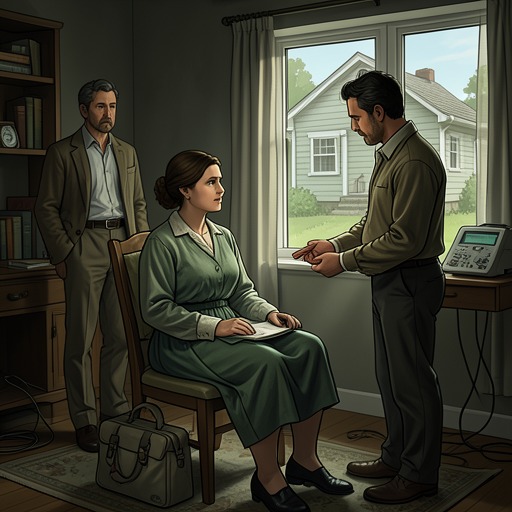
Pat brought Sean by car from the barracks, and they drove straight to Aughawillan. At the little iron gate, Sean was so overcome by longing that he scarcely noticed what was around him. Maggie had cycled out after school to be with Susan; when the women heard the car, they came outside. Sean initially drew back, self-conscious and barely able to walk beside his uncle along the new cinder path. Only when he was nearer did he run to his mother and let himself be gathered into her arms. His tears embarrassed him, while Maggie teased him for losing his words despite his usual talk and questions.
The first welcome inside was domestic and concrete: a large fire of branches burned in the open hearth, a kettle hung from a swinging black iron rail, and Maggie had brought a sweet cake from town. Pat said that the others were the best in the barracks and would come down the following week. Sean could taste neither tea nor cake. His attention remained on Susan’s return and on the reassurance of being close enough to touch her sleeve. She smiled and attended to everything, though at times she looked close to tears; joy did not remove the strain of what had passed.
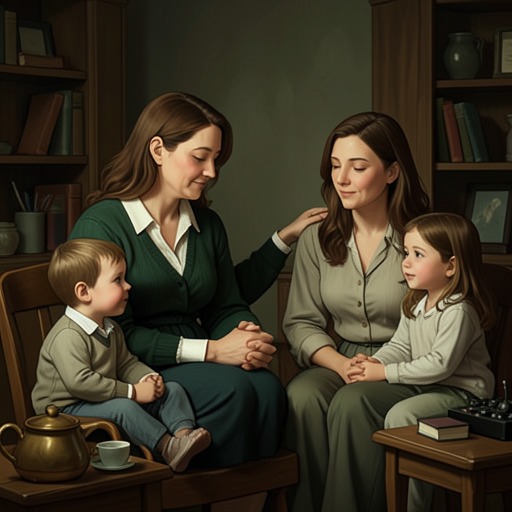
Their conversation makes the separation plain without making it the whole of the meeting. Susan had heard that Sean was a good boy and had caught big fish with Daddy in the boat. He listed pike, perch, and eels. When he told her that the children had not liked school and had feared she might never return, she explained quietly that she had been in hospital, sick and on her own while people tried to make her better. She hoped he had prayed for her. Maggie went outside, and Pat climbed the short wooden stairs to inspect the bedrooms, leaving the exchange between mother and son with room to settle. Sean answered that they had prayed for her at the Rosary every night, and that he had prayed alone for God to send her home.
From reunion to family household
The first week at Corramahon gave mother and son a short period together before the others arrived. The memoir recalls these days as happy: Susan helped Sean with school exercises he found difficult, and, after the lamp was lit but before the family knelt for the Rosary, their conversation could run on until she firmly told him it was time to sleep if he was to be alert for school. The ordinary limits of evening and morning return here as signs of a life being assembled again, not as proof that the earlier separation has been forgotten.
That private interval ended when the rest of the family came from the barracks in a small red turf lorry. Bridgie McGovern sat in the cab with Dympna; Breedge, Rosaleen, Monica, and Margaret rode among beds, furniture, bedding, mattresses, pots, and pans in the crates. When the pins were removed and the boards lowered, the children and belongings were lifted down. Susan kissed each child in turn and took Dympna from Bridgie. She looked disappointed for a moment when Bridgie explained that Francis could not come because of his duties, but the children’s cries and competition for her attention soon filled the house. The homecoming widened from a reunion between two people into the return of the family to one another.
The next school mornings made that restoration visible in routine. The children walked with Susan along the cinder footpath to the iron gate, carrying books and lunches in dark-blue cloth schoolbags she had made from decommissioned police trousers. They passed Brady’s pool, the old Mahon brothers’ house and the deep quarry, crossed the railway bridge, and climbed past Mahon’s shop. At the school, Susan used her large key to open the building when Master McMurrough was late. Corramahon’s reunion thus leads directly into a renewed daily life: a mother walking her children to school, a house filling with family, and familiar obligations beginning again after illness and separation.